White Paper
Juan Velasco13 min readOctober 5, 2026Audited & Controlled AI vs. Personal AI in Companies: The Invisible Risk That Threatens Your Organization
Employees are sending your company's most sensitive data to personal AI accounts — code, financials, customer records, legal strategies. This white paper reveals the five critical risks of Shadow AI and provides C-level leaders with a practical framework to implement audited, controlled enterprise AI before a breach forces your hand.
enterprise AI
Shadow AI
data security
AI governance
compliance
C-level
data leakage
risk management
AI policy
information security
Audited & Controlled AI vs. Personal AI in Companies: The Invisible Risk That Threatens Your Organization
Executive Summary
Across every industry, employees are plugging sensitive company data into personal AI accounts — ChatGPT, Gemini, Claude, Copilot — without authorization, oversight, or audit trails. This phenomenon, known as Shadow AI, mirrors the Shadow IT problem that kept CISOs awake a decade ago, but with a critical difference: AI doesn't just store your data — it learns from it, replicates it, and can leak it to competitors.
This white paper is written for CEOs, CTOs, CISOs, CFOs, and board members who need to understand:
- Why personal AI accounts represent an unquantified enterprise risk
- How data leakage through AI tools can trigger regulatory fines, IP loss, and reputational damage
- What audited and controlled AI looks like — and why it's the only viable path forward
- A practical framework to assess your organization's exposure today
The bottom line: If your employees are using personal AI accounts for work, you already have a data governance problem. The question is not if it will surface — it's when, and how badly.
1. The Shadow AI Problem: What Your Employees Are Doing Right Now
The Scale of Unauthorized AI Usage
Industry surveys and internal audits consistently reveal a striking pattern:
- 60–80% of knowledge workers in mid-to-large enterprises use at least one personal AI tool for work-related tasks
- They paste code, customer data, financial models, legal drafts, strategic plans, and proprietary research into these tools daily
- Most IT and security teams are unaware of the full extent of this usage
Common Scenarios
| Employee Role | What They Paste Into Personal AI | What's Actually at Risk |
|---|---|---|
| Software Engineer | Source code, API keys, architecture diagrams | Intellectual property, security vulnerabilities |
| Financial Analyst | Revenue models, M&A targets, forecasts | Material non-public information, competitive intelligence |
| Marketing Manager | Campaign strategies, brand plans, pricing | Go-to-market intelligence, trade secrets |
| HR Professional | Employee records, compensation data, termination plans | PII, labor law violations, privacy breaches |
| Legal Counsel | Contract drafts, litigation strategy, regulatory filings | Attorney-client privilege, case strategy |
| Sales Executive | Client lists, deal pipelines, pricing negotiations | Customer relationships, revenue forecasts |
Why This Happens
The root cause is simple: productivity pressure outpaces governance. Employees discover that AI tools can save them hours of work. The tools are free, accessible, and require no approval. By the time the organization notices, the habit is entrenched.
2. Five Critical Risks of Personal AI in the Enterprise
Risk 1: Data Leakage to Third Parties
When an employee submits data to a personal AI account, that data is transmitted to the provider's servers. Depending on the provider's terms of service:
- Data may be used to train future models — meaning your competitor's employee could eventually receive outputs influenced by your proprietary information
- Data may be stored indefinitely in the provider's infrastructure, subject to their security posture, not yours
- Data may be accessible to the provider's employees (engineers, contractors, support staff) under their internal access policies
- Data may be shared with subprocessors in jurisdictions with different privacy protections
Real-world parallel: In 2023, Samsung employees pasted proprietary source code into ChatGPT. The code was stored on OpenAI's servers. Samsung subsequently banned internal use of generative AI tools.
Risk 2: Regulatory and Compliance Violations
Depending on your industry and geography, personal AI usage may violate:
| Regulation | What's at Stake |
|---|---|
| GDPR (EU) | Personal data processed without a lawful basis; data transfers to non-adequate countries; fines up to 4% of global revenue |
| HIPAA (US Healthcare) | Protected health information (PHI) disclosed to unauthorized parties; fines up to $1.9M per violation category |
| SOX (US Public Companies) | Financial data controls bypassed; audit trail integrity compromised |
| CCPA/CPRA (California) | Consumer data shared without consent; private right of action for breaches |
| PCI-DSS (Payments) | Cardholder data exposed to unauthorized processors |
| ISO 27001 / SOC 2 | Control environment gaps; certification jeopardy |
The compounding problem: Most organizations cannot demonstrate compliance because they cannot detect what data has been sent to personal AI accounts. There is no log, no audit trail, no DLP policy covering these channels.
Risk 3: No Audit Trail, No Accountability
Enterprise AI platforms provide:
- Complete logging of inputs and outputs
- User attribution (who asked what, when)
- Data retention and deletion controls
- Integration with SIEM and DLP systems
Personal AI accounts provide none of this. When a breach occurs — and it will — the organization faces:
- Inability to determine what data was exposed
- Inability to determine who exposed it
- Inability to demonstrate due diligence to regulators, auditors, or litigants
- Inability to contain the breach because the data resides on external infrastructure you don't control
Risk 4: Uncontrolled Bias and Hallucination
Personal AI tools can produce confident but incorrect outputs. When employees use these outputs in business decisions — financial models, legal interpretations, technical architectures — they introduce:
- Factual errors that propagate through business processes
- Bias from training data that doesn't reflect your industry, market, or customer base
- Hallucinated citations — references to cases, studies, or regulations that don't exist
- No quality gate — no review, no validation, no version control
In regulated industries, this is not just a quality problem — it's a liability problem.
Risk 5: Vendor Lock-in and Data Sovereignty
When critical business knowledge flows through personal accounts at multiple providers:
- Your organization's collective intelligence is distributed across external platforms
- Switching costs become prohibitive because the knowledge is embedded in model weights, not in your systems
- Data sovereignty requirements (data must remain in-country) are silently violated
- Business continuity depends on third-party availability and policy decisions you cannot influence
3. Audited & Controlled AI: The Enterprise Alternative
What Makes AI "Audited and Controlled"?
An enterprise-grade AI deployment is fundamentally different from personal AI accounts. Here's the comparison:
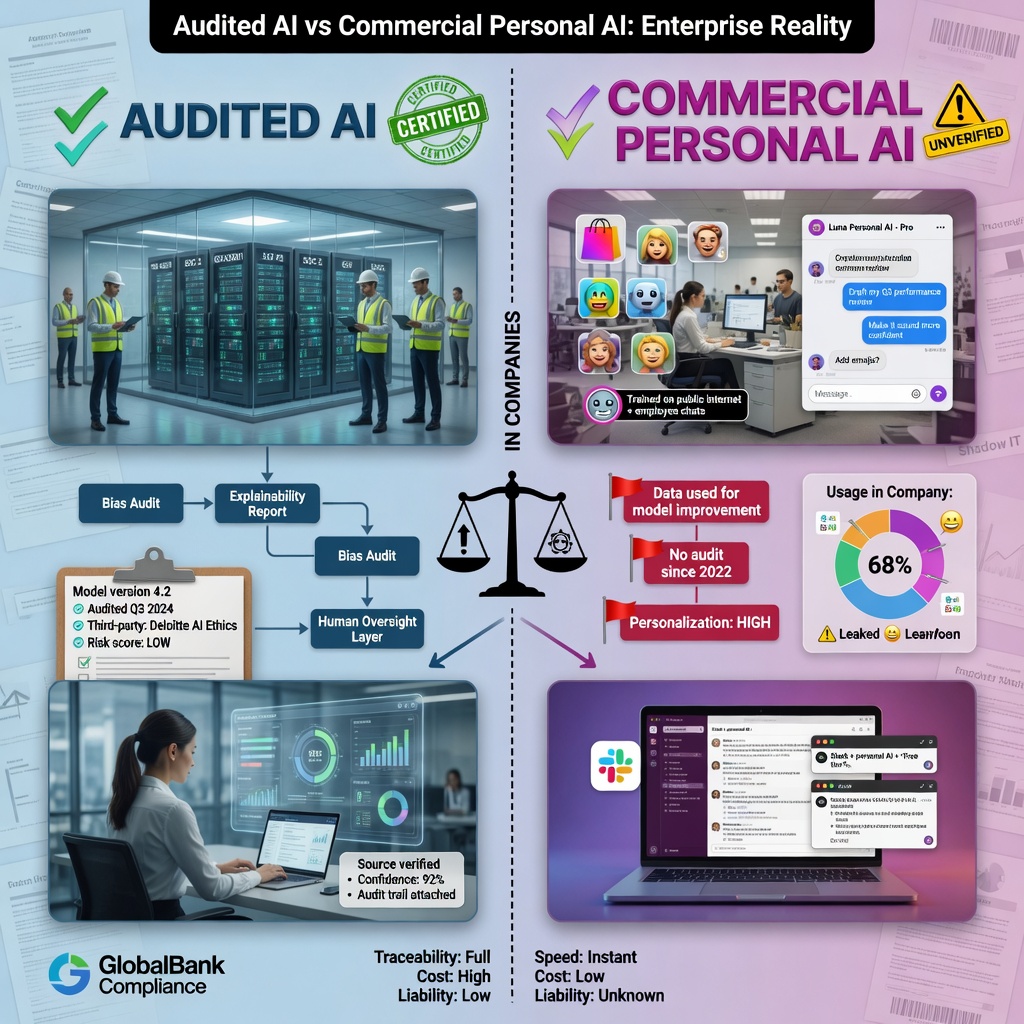
| Dimension | Personal AI Accounts | Audited & Controlled Enterprise AI |
|---|---|---|
| Data ownership | Provider's terms govern your data | Your organization retains full ownership and control |
| Data training | Your data may train public models | Your data is never used for model training |
| Access control | Individual personal accounts | Role-based access, SSO, MFA enforced |
| Audit trail | None | Complete logging of every interaction |
| Data retention | Provider's policy | Your policy — including deletion on demand |
| Compliance | Not guaranteed | Designed for GDPR, HIPAA, SOC 2, ISO 27001 |
| Integration | Standalone, copy-paste workflow | Integrated with your systems, databases, and workflows |
| Model governance | No visibility | Model versioning, drift monitoring, bias testing |
| Output quality | No validation | Guardrails, fact-checking, human-in-the-loop |
| Cost management | Uncontrolled, per-employee | Centralized licensing, usage analytics, budget controls |
| Security | Consumer-grade | Enterprise security: encryption at rest and in transit, network isolation, penetration testing |
| Accountability | Individual employee | Clear governance: who approved, who monitored, who is responsible |
The Architecture of Controlled AI
A properly governed enterprise AI deployment includes:
- Centralized Platform — A single, organization-controlled AI environment (not scattered personal accounts)
- Identity & Access Management — SSO integration, role-based permissions, least-privilege access
- Data Classification & DLP — Automatic detection and blocking of sensitive data before it reaches any AI model
- Audit Logging — Every prompt, every response, every user action logged and available for compliance review
- Model Governance — Approved models, version control, performance monitoring, bias testing
- Integration Layer — AI connected to your actual business systems (CRM, ERP, document management) — not requiring copy-paste
- Retention & Deletion Policies — Automated data lifecycle management aligned with regulatory requirements
- Incident Response — Defined procedures for AI-related security incidents, including containment and notification
4. Real-World Scenarios: What Can Go Wrong
Scenario A: The M&A Leak
A financial analyst at a mid-cap investment bank is working on a confidential acquisition target analysis. To speed up financial modeling, they paste the target's unaudited financials into their personal ChatGPT account. The data is transmitted to the provider's servers, logged in the user's conversation history, and — under the provider's then-current terms — may be used for model training.
Consequences:
- If the deal is material, this constitutes a selective disclosure violation
- The target company's confidential information is now on external infrastructure
- If discovered, the deal could be compromised, triggering legal liability and reputational damage
- Regulatory investigation into the bank's information barriers
Scenario B: The Healthcare Data Breach
A hospital administrator uses a personal AI account to draft patient communication templates. They paste de-identified patient data to get better output. However, the "de-identified" data still contains enough context to be re-identified.
Consequences:
- HIPAA violation — PHI disclosed to an unauthorized processor
- Potential OCR investigation and fines
- Patient notification requirements triggered
- Class action litigation risk
Scenario C: The Source Code Exposure
A senior developer pastes a proprietary algorithm into an AI coding assistant to debug it. The code includes embedded API keys and references to internal infrastructure.
Consequences:
- Intellectual property exposed to the AI provider
- API keys potentially compromised
- Security architecture revealed
- If the provider's terms allow training use, the algorithm's logic may influence future outputs available to competitors
5. The Decision Framework for C-Suite Leaders
Questions Every CEO Should Ask
- Do we have a policy on AI tool usage? If yes, is it enforced? If no, why not?
- Can we detect which employees are using personal AI accounts for work? If not, we have Shadow AI.
- What would happen if our most sensitive data was found on an external AI provider's servers? Can we quantify the exposure?
- Are we prepared for a regulatory inquiry about AI data practices? Can we demonstrate due diligence?
- Do our contracts with clients and partners include AI usage restrictions? Are we compliant?
Questions for the CTO / CISO
- Is AI tool usage covered in our DLP (Data Loss Prevention) strategy?
- Do our SIEM logs capture AI tool access patterns?
- Have we assessed the data residency implications of our employees' AI usage?
- Do we have an approved enterprise AI platform, or are we relying on ad hoc personal accounts?
- What is our incident response plan for an AI-related data breach?
Questions for the CFO
- What is the total cost of uncontrolled AI usage? (Personal subscriptions, productivity loss from bad outputs, potential regulatory fines)
- What is the cost of an enterprise AI platform vs. the cost of a data breach?
- Are we getting ROI from AI, or are we getting risk without the benefit?
- How would an AI-related regulatory fine impact our financials?
Questions for the CHRO
- Are employees trained on acceptable AI usage?
- Do employment agreements address AI tool usage and IP assignment?
- Is AI literacy part of our professional development strategy?
- How do we balance productivity enablement with risk management?
6. The Roadmap: From Shadow AI to Governed AI
Phase 1: Discovery (Weeks 1–4)
- Audit current AI usage across the organization (surveys, network traffic analysis, SSO logs)
- Classify data types being sent to personal AI tools
- Map regulatory requirements that apply to your AI usage
- Identify high-risk departments and use cases
Phase 2: Policy & Governance (Weeks 4–8)
- Draft an AI Acceptable Use Policy covering personal and enterprise AI
- Define data classification rules for AI interactions (what can and cannot be sent to AI)
- Establish an AI governance committee with representation from Legal, IT, Security, Compliance, and Business
- Update employment agreements and vendor contracts as needed
Phase 3: Platform Selection & Deployment (Weeks 8–16)
- Evaluate enterprise AI platforms against your requirements (security, compliance, integration, audit)
- Select and deploy an audited, controlled AI environment
- Integrate with existing identity management, DLP, and monitoring systems
- Configure data guardrails — automatic blocking of sensitive data categories
Phase 4: Migration & Training (Weeks 12–20)
- Migrate users from personal accounts to the enterprise platform
- Conduct organization-wide training on acceptable AI usage
- Provide role-specific training for high-risk departments (Legal, Finance, Engineering, Healthcare)
- Decommission personal accounts used for business purposes
Phase 5: Continuous Monitoring (Ongoing)
- Monitor AI usage patterns for policy violations
- Conduct periodic audits of AI interactions and data flows
- Update policies as regulations evolve and new AI capabilities emerge
- Report to the board on AI governance metrics quarterly
7. The Cost of Inaction
What Happens If You Do Nothing?
| Risk Category | Potential Impact |
|---|---|
| Data breach | Average cost of a data breach: $4.45M (IBM 2023). AI-mediated breaches may be harder to contain and more expensive. |
| Regulatory fine | GDPR: up to 4% of global annual revenue. HIPAA: up to $1.9M per violation category. |
| IP loss | Irreversible. Once proprietary information influences a public AI model, it cannot be "unlearned." |
| Reputational damage | Clients and partners will question your governance. Competitors will use it against you. |
| Legal liability | Class action lawsuits, shareholder litigation, contractual breach claims. |
| Competitive disadvantage | While you manage risk reactively, competitors build governed AI capabilities that accelerate their business. |
The ROI of Governed AI
Organizations that deploy audited, controlled AI gain:
- Productivity gains — employees use AI more effectively when it's integrated with their actual tools
- Risk reduction — auditable, compliant AI usage that withstands regulatory scrutiny
- Competitive advantage — proprietary data used safely to generate insights competitors cannot access
- Cost optimization — centralized licensing replaces scattered personal subscriptions
- Innovation acceleration — governed AI enables experimentation without fear of uncontrolled exposure
8. Recommendations: What to Do This Week
Immediate Actions (Next 7 Days)
- Issue an interim policy on personal AI usage — at minimum, prohibit sending confidential, regulated, or proprietary data to personal AI accounts
- Communicate the policy to all employees with clear examples of what is and isn't allowed
- Begin an informal audit — survey department heads about AI tool usage in their teams
- Engage Legal and Compliance to assess regulatory exposure
Short-Term Actions (Next 30 Days)
- Form an AI governance committee with cross-functional representation
- Evaluate enterprise AI platforms that meet your security, compliance, and integration requirements
- Implement technical controls — DLP policies, network monitoring for AI tool access
- Begin employee training on AI risks and acceptable usage
Medium-Term Actions (Next 90 Days)
- Deploy an enterprise AI platform with full audit, access control, and data governance
- Migrate users from personal accounts to the governed platform
- Establish ongoing monitoring and reporting to the board
- Review and update contracts with clients and partners to address AI usage
Conclusion: The Window Is Closing
Every day your employees spend using personal AI accounts for work is a day your organization accumulates unquantified, uncontrolled risk. The data is already out there — in external servers, in model training pipelines, in conversation logs you cannot access or delete.
The question is no longer whether your organization needs governed AI. It's whether you'll choose to implement it proactively — or react to a breach, a fine, or a headline that forces your hand.
The organizations that move now will build AI capabilities on a foundation of security, compliance, and accountability. The organizations that wait will spend years — and millions of dollars — catching up.
About ArcanFlows™
ArcanFlows™ is an enterprise AI platform designed for organizations that need AI that works — not just talks. With built-in audit trails, role-based access control, data governance, and seamless integration with your existing business systems, ArcanFlows™ enables your teams to harness the power of AI without the risk of Shadow AI.
AI that works. Governed. Audited. Controlled.
This white paper is intended for informational purposes and does not constitute legal advice. Organizations should consult with their legal and compliance teams regarding specific regulatory requirements.